Within the high-stakes realm of today's serious oversteer competition, podium finishes is no longer solely a product of raw engine power or driver courage. Instead, it has become a multifaceted engineering challenge that necessitates a painstaking marriage of selecting a time-tested vehicle platform, equipping it with the highest-quality competition hardware, and, most importantly, comprehending its live characteristics on the circuit through cutting-edge suspension tuning applications. This comprehensive guide functions as your blueprint starting from the very first concept of a competition vehicle right through to the final engineering-refined refinements that elevate a powerful vehicle into a consistent champion. We will thoroughly explore the precise engineering of chassis dynamics adjustment, showing how a advanced vehicle dynamics tool like precise measurement hardware removes guesswork and delivers unparalleled insight into your vehicle's real-world performance.
The cornerstone of any successful competitive sliding vehicle is, without question, the chassis itself. Several platforms have earned iconic standing within the international drifting scene due to their natural handling characteristics, robust build quality, and the immense availability of aftermarket components available. Picking the optimal car is the primary and most significant decision a builder will make. For instance, the the E36 generation BMW is universally acknowledged as among the greatest overall cars for drifting of the modern era. Its excellent 50/50 weight distribution, combined with a rear-wheel-drive configuration and bulletproof inline-six motors, forms a chassis that is both forgiving for beginners and highly competitive in the control of a pro pilot. The successor of this concept, the BMW E46 platform, refines these qualities with a even more developed frame, broader wheel track for improved high-speed stability, and still a greater degree of lock directly from the manufacturer. Another formidable contender in the professional scene is the Chevrolet Corvette C6.
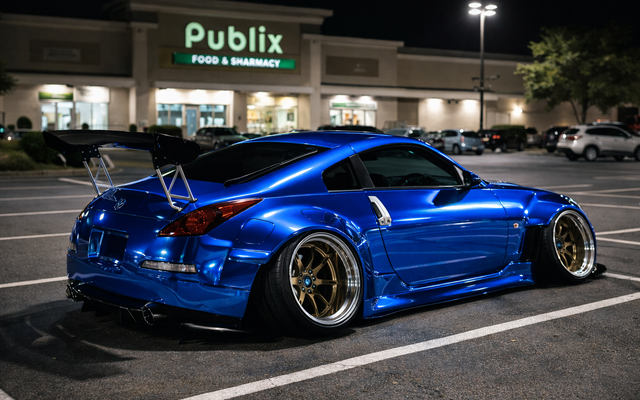
This American track weapon offers a particular array of benefits to the drifting world, featuring a low-mass alloy frame, a transaxle-style transaxle that contributes to an perfect front-to-rear mass ratio, and the tremendous low-end power of a large-displacement GM LS engine. This fusion renders it an absolute force on track, designed of starting and maintaining continuous slides with seemingly effortless deployment of power. For those desiring outstanding value, the Nissan Z33 rises above as a prime candidate. It comes from the manufacturer with a rigid chassis, a decent OEM limited-slip differential, and the responsive VQ35DE motor that offers ample horsepower and torque for learning and moving up in the activity. Its follow-up, the 370Z model, brings additional refinements in structural rigidity, steering geometry, and peak engine power, cementing its position as a favorite selection among serious drivers. Further iconic vehicles that deserve consideration include the nimble unique FC generation RX-7, the most popular Nissan S13 240SX, the V8-powered Ford Mustang SN95, the more recent BMW E90, and the small yet surprisingly playful and teachable MX-5 Miata. All of these platforms offers a unique set of traits, complexities, and potentials, but they all have in common the core components necessary to be transformed into a serious sliding vehicle.
However, selecting the correct car is just the beginning. To unlock the full performance of every of these vehicles, significant modifications to the steering system and chassis control systems are utterly non-negotiable. This is where the realm of specialist tuning hardware becomes vital focus. The single most impactful modification for a serious competition vehicle is the integration of a drift-spec drift angle kit. These sophisticated kits, such as those developed by specialist companies like SLR Speed, are engineered to dramatically enhance the car's available turning lock. A standard production vehicle is highly limited in how far its steering tires can pivot, a design compromise for public road operation. In drifting, but, aggressive steering input is constantly necessary to manage and sustain a slide. An steering kit substitutes the stock hubs, tie rods, and often suspension arms with components that enable the wheels to reach angles over 70 or even 80 degrees, as opposed to a typical OEM setting of around 40 to 50 degs.
This vastly expanded capability gives the operator with exponentially greater control during a slide, enabling it to be far more straightforward to initiate a drift, hold it through a sweeping turn, and switch smoothly from one side to the other. The difference in drivability is truly transformative. Paired with a appropriately chosen angle kit is the every bit as essential upgrade to the chassis's damping system. Off-the-shelf or including high-end sport adjustable suspension are simply not engineered for the specific and brutal demands of drifting. A dedicated set of coilovers is paramount. These engineered suspension components have unique damping rates and spring stiffness that are tuned for the violent weight transfer that is characteristic of aggressive driving. When a operator starts a slide, the vehicle's mass is shifted rapidly to the outer of the corner. Correct performance suspension manage this transfer in a predictable way, permitting the car to settle quickly and offering the pilot precise feel through the controls and driver's seat. They also enable exact tuning of stance, rebound and compression firmness, and weight balance, which are all key elements of fine-tuning the car's dynamics to a particular circuit or competition approach. As a system, a precision-engineered steering angle kit and a expertly specified set of performance adjustable dampers constitute the core mechanical base upon which all later tuning is based.
Once the core components is fitted, the next critical stage in the project is the precise adjustment of the chassis's wheel angles. This is the world of vehicle alignment optimization, a methodology that can appear overwhelmingly complex to the beginner but is, in fact, the defining factor to turning a collection of capable parts into a harmonious and predictable whole. The most critical aspect of suspension geometry for drifting is certainly camber angle. Wheel camber is the angle of the tire in relation to the vertical line when looked at from the forward of the vehicle. When the top edge of the wheel is leaning towards the chassis, this is known as negative camber. For oversteer driving, negative camber on the front tires is generally used and is regarded as critical. The purpose is drift tuning app deeply tied to vehicle dynamics.
When drift tuning app a car is turning at extreme sideways angles, the frame leans toward the external of the corner. This chassis roll causes the outer steering tire to lose its best footprint with the tarmac. By applying inward lean, the tire is pre-tilted to account for this lean. As the chassis rolls into the corner, the outside front tire gains a better contact patch on the road surface, optimizing its grip at the critical time when it is needed most for directional command. Usually, front axle angles for a dedicated sliding vehicle range from approximately -3 degrees to as high as -5 degrees or even greater, contingent on the details of the vehicle configuration, compound selection, and operator style. The back wheels also employ inward tilt, but the values are generally more conservative and subtler than the front axle. Excessive inward lean at the back can cause the vehicle to extremely loose and hard to control on throttle input, as it reduces the available contact patch of the powered tires during straight-line power delivery. Hence, rear angles are commonly in the range of -1 degree to -3 degrees, finding a precise balance between providing sufficient lateral grip to assist in entering and sustaining the drift while also keeping usable traction for acceleration the bend. camber angle is just one part of the larger suspension geometry picture, which additionally includes toe angle, caster, and steer correction correction.
Toe angle is the direction of the tires when viewed from the top. Toe-in means the front edges of the tires are closer together than the rear edges, while negative toe means the opposite. For sliding, a modest amount of front toe out is commonly used to quicken the initial response steering reaction, making the chassis feel more agile and willing to start a slide. Rear axle toe setting is generally set to zero or a very small amount of toe-in to foster predictability under throttle. caster angle is the forward or backwards tilt of the kingpin axis when viewed from the side-on of the vehicle. Increased caster improves steering feel and high-velocity stability, and it additionally adds to inward lean effect during steering, which is extremely advantageous. Adjusting these values is a intricate interplay where a change to a single parameter can and often will impact the other settings. The traditional process for tuning a car's suspension geometry for sliding has long been a labor-intensive affair of trial and error. A tuner or crew would introduce a adjustment based on experience, run the car on track, depend on the pilot's individual perception and comments, and then apply a further adjustment. This cycle would iterate time after time until the vehicle felt "right" or the available track period ended. This approach is not only incredibly wasteful in terms of hours and tires, fuel, and parts, but it is also deeply inaccurate.
Driver feel is a famously inconsistent metric, influenced by many factors such as fatigue, changing track conditions, temperature, and simply the mood of the driver on that particular day. What feels "loose" on one pass might feel "pushing" on the subsequent pass, causing contradictory data and counterproductive changes. This long-standing problem in vehicle dynamics optimization is exactly where contemporary technology has stepped in to revolutionize the landscape.
The development and integration of sophisticated suspension tuning applications has ushered in a new age for engineering and perfecting professional drift cars. These systems, exemplified by groundbreaking solutions like data acquisition tools, work by actively recording the actual dynamic performance of the chassis as it is piloted on the course. As opposed to using driver feedback, these devices acquire measurable information on critical variables such as shock absorber movement, corner velocities, acceleration forces, wheel angle, and driver input position. This collected data stream is then processed by sophisticated applications that can plot and analyze the information in a clear format. For the first time ever, engineers and teams can visualize specifically what the vehicle is doing at every point of a slide. This function revolutionizes the entire alignment optimization process. Imagine the specific task of setting the front camber for a given car. Rather than introducing a change from -3 degrees to -3.5 degrees and then testing several passes to try and "feel" a change, a telemetry system can provide immediate and clear data. The tool can indicate graphically how the wheel's grip is performing during the key phases of a slide: the initial flick, holding the angle, and transition. It can demonstrate if the current camber setting is enabling the steering tire to keep optimal contact or if the compound is working inefficiently on its external edge.
The system can after analysis suggest empirical advice for change. Perhaps the information indicates that the outside front tire is even overworking its edge at -3.5 degrees of camber, indicating that an increase to angle, say -4 degrees, might be beneficial. Conversely, the information might indicate that the tire is not achieving optimal operating temp or that the inside shoulder is degrading too quickly, which could point to that there is too much negative camber and a modest decrease back to -3.2 degrees would be more efficient. This degree of accuracy and practical intelligence was completely unattainable in the era of solely mechanical setup.
The benefit of employing a advanced vehicle dynamics tool reaches far beyond just dialing in camber angles. It serves as an priceless damper adjustment manual that is customized to your specific chassis. When fine-tuning the shock absorber settings on your suspension, rather than relying on general guidelines or copying another car's settings, you can utilize the data to analyze how the vehicle is behaving in relation to suspension engineering your tweaks. The tool can show the suspension travel data over a lap, showing if the shocks are controlling the body movement optimally or if they are causing the car to oscillate too much after a direction change. It can assist in identifying problems like hitting the bump stops or losing droop, permitting you to introduce data-backed decisions to spring preload, rebound/compression values, or ground clearance. This approach extends just as well to the intricate art of corner balancing. In addition to camber angle, the system can give insight into how modifications to toe and caster are impacting the vehicle's handling during specific parts of a slide. For example, it can allow you to ascertain the ideal amount of front negative toe for your individual angle kit configuration and piloting technique by analyzing the quickness of initial response and the predictability of the vehicle at lock lock. This makes the software an incredibly powerful performance optimization handbook that is constantly updated by the live performance of your specific chassis on the circuit. It shifts the entire project from a subjective skill into a scientific optimization process.
Furthermore, the application of a tool like modern telemetry is not limited to professional tuners with vast funding. For the amateur driver, it acts as an powerful equalizer. It effectively offers the driver with the insight of a expert dynamics engineer without needing the associated overhead. It accelerates the learning curve by giving clear directions to problems that would otherwise take years of experience to solve. A driver can see how their particular vehicle reacts to specific adjustments, building a more profound understanding of car control in the process. It additionally democratizes advanced suspension engineering principles, allowing every enthusiast with the drive to optimize their machine to do so in a efficient and effective way. This is notably important in a activity like drifting, where tuning expertise has historically been a tightly held advantage among top drivers. In the modern era, that knowledge can be in the garage of every dedicated driver.
In the final analysis, the journey to engineering and optimizing the ultimate championship-contending drift machine is a comprehensive endeavor that perfectly blends proven mechanical principles with revolutionary telemetry technology. It begins with the wise choice of a legendary car, followed by the integration of essential competition parts like drift-spec drift angle kits and correctly specified performance suspension units. The build then moves into the detailed realm of alignment optimization, where settings like camber angle, toe setting, and caster angle are carefully set to suit the car's modified geometry and the pilot's individual needs. The final step, and what really differentiates the today's process from the traditional methods, is the adoption of a advanced suspension tuning application. This system removes the uncertainty and waste of purely subjective tuning by providing empirical, actual telemetry on how the car is actually performing. It acts as an indispensable engineering partner, a definitive alignment optimization handbook, and a comprehensive performance analyzer. Together, this holistic philosophy guarantees that each and every aspect of the competition vehicle—from the pick of the platform to the final tweak on the coilover—is optimized for ultimate success on the circuit. It represents the total maturation of the sport of oversteer driving, merging raw pilot talent with surgical suspension engineering to forge the ultimate effective vehicles possible.